
How to Rank on Google in 2026: A Complete SEO Guide for Beginners and Businesses
Google SEO in 2026: Practical Strategies for Organic Rankings, AI Search Visibility, and Sustainable Traffic
Ranking on Google in 2026 requires more than adding keywords to a webpage or building backlinks. You need to understand what people are searching for, create content that genuinely answers their questions, make your website accessible to search engines, and build trust with your audience. Search is also evolving. Google AI Overviews, AI Mode, and other AI-powered discovery experiences are changing how people find and consume information. However, strong SEO fundamentals remain important for helping search engines discover, understand, and present your content. Whether you are a beginner, blogger, freelancer, or business owner, this guide explains how to improve your Google rankings using practical, sustainable SEO strategies.
What Is SEO, and How Does Google Ranking Work in 2026?
Search engine optimization (SEO) is the process of improving your website so search engines can discover, understand, and present its pages to relevant users.
Google Search generally involves three stages:
Crawling: Google discovers pages through links and other available discovery methods.
Indexing: Google processes information about discovered pages and may store them in its index.
Serving search results: Google’s ranking systems select and order relevant results for a particular search.
A page is not guaranteed to pass through every stage. For example, a page can be crawled without being indexed, and an indexed page is not guaranteed to rank prominently.
Google uses multiple systems and signals to evaluate relevance, usefulness, quality, and other aspects of search results. There is no single trick that guarantees first-page rankings.
1. Find the Right Keywords Before Writing Content
Keyword research is the foundation of an effective SEO strategy. It helps you understand the language people use when searching for information, products, and services.
However, choosing keywords only because they have high search volume can waste your time. A keyword should match your audience, business goals, and the purpose of your webpage.
How to find valuable keywords
Start by brainstorming questions your target audience might ask. For a digital marketing website, examples include:
- How to rank on Google in 2026?
- How to find low-competition keywords?
- What is technical SEO?
- How to improve website traffic?
- How to optimize a WordPress website for SEO?
Use tools such as Google Keyword Planner, Google Trends, Google Search Console, and Ubersuggest to investigate keyword ideas, search demand, competition, and existing website performance.
Next, evaluate three things:
Search intent: What does the user want to accomplish? They might want information, compare products, find a business, or make a purchase.
Competition: Examine the pages currently ranking. Identify their strengths, weaknesses, content gaps, and the depth of information they provide.
Relevance: Decide whether attracting visitors searching for that phrase will help your website serve its intended audience.
For example, someone searching for “what is SEO” probably wants an explanation. Someone searching for “SEO services for small businesses” may be comparing service providers.
Create a separate, useful page for each distinct search intent rather than publishing several nearly identical pages targeting the same keyword .
2. Understand Search Intent and Create Better Content
Understanding search intent is one of the most important steps in content planning. Your article must solve the problem that brought the reader to Google.
Before writing, search your target keyword and examine the results. Look at the types of pages appearing, the questions they answer, and the information readers may still need.
If the results mainly contain tutorials, publishing a short promotional page may not satisfy the searcher’s needs.
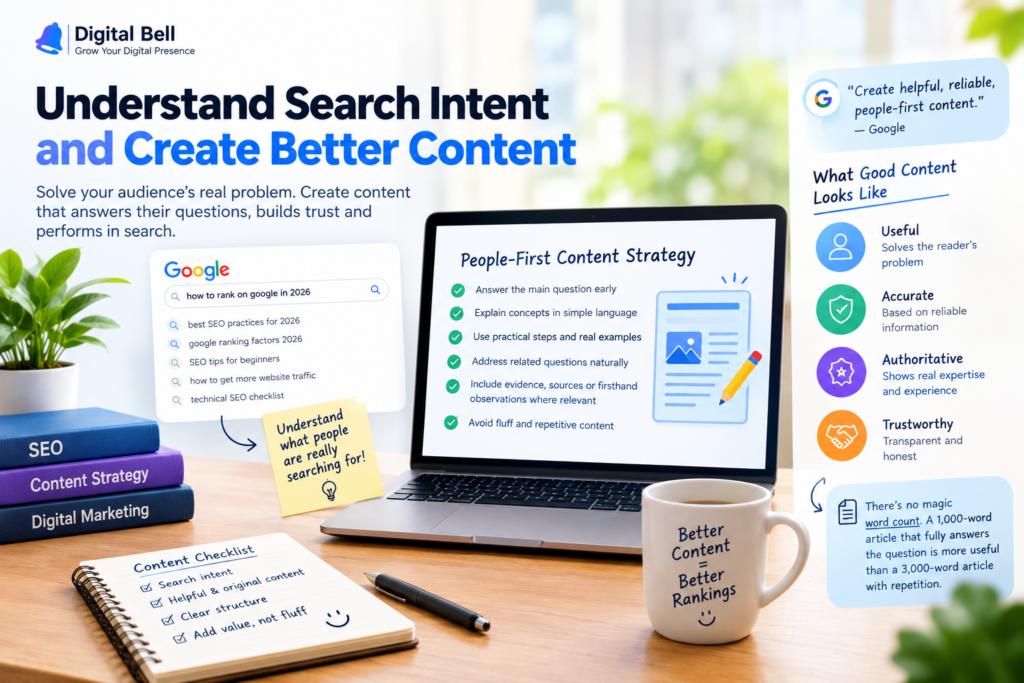
Use a people-first content strategy
A useful article should:
Answer the main question early.
Explain concepts in clear, accessible language.
Include practical steps and relevant examples.
Address related questions naturally.
Provide evidence, sources, or firsthand observations where appropriate.
Avoid unnecessary introductions and repetitive paragraphs.
For instance, an article about improving website rankings should not merely list SEO techniques. It should explain how to implement them, which tools can help, and how to measure progress.
Google’s guidance on creating helpful, reliable, people-first content emphasizes original value, accuracy, clear authorship, and content created primarily to help people.
Remember: Google does not prescribe a universal ideal word count. A 1,000-word article that fully answers a question can be more useful than a 3,000-word article filled with repetition.
Optimize Your On-Page SEO
On-page SEO helps users and search engines understand the topic and purpose of each page.
Start with the following elements.
Title tag
Write a unique, descriptive title that communicates the page’s main topic. Include your primary keyword naturally when appropriate.
Example: How to Rank on Google in 2026: A Practical SEO Guide
Avoid exaggerated promises such as “Guaranteed #1 Google Ranking in 24 Hours.”
Main heading and subheadings
Use one clear main heading and organize the article with descriptive subheadings.
For example:
H1: How to Rank on Google in 2026
H2: How Keyword Research Works
H2: How to Improve Technical SEO
H3: How to Fix Common Indexing Problems
Use headings to organize information, not simply to insert additional keywords
Meta description
Write a concise summary that explains what readers will learn. A meta description can help communicate relevance and encourage clicks, although Google may generate a different search snippet.
Example:
“Learn how to rank on Google in 2026 with practical keyword research, on-page SEO, technical improvements, quality content, and AI search optimization.”
URL structure
Use short, descriptive URLs where practical.
Example: yourdomain.com/how-to-rank-on-google/
Avoid unnecessarily long URLs containing dates, random numbers, and repeated keywords.
Images and internal links
Use relevant images, descriptive filenames, and meaningful alternative text when an image conveys useful information.
Add internal links to related articles so visitors can explore topics in greater depth. For example, this guide could link to a detailed tutorial on keyword research or a technical SEO checklist.
Internal links should help readers navigate your website, not exist solely to manipulate rankings.
Improve Technical SEO and Website Performance
Even excellent content can struggle to perform if important technical problems prevent Google from accessing or understanding it.
Start with a basic technical audit.
Check crawling and indexing. Use Google Search Console to inspect important URLs, review indexing reports, and identify technical issues. A sitemap can help Google discover your preferred URLs, but submitting one does not guarantee indexing.
Use HTTPS. Secure connections protect information exchanged between websites and visitors.
Optimize mobile usability. Make sure text is readable, navigation works properly, and important content is accessible on mobile devices.
Improve loading performance. Compress oversized images, reduce unnecessary scripts, and choose reliable hosting.
Fix broken links and incorrect redirects. These problems can disrupt navigation and waste crawling resources.
Use canonical URLs appropriately. Canonical tags can help consolidate signals when substantially similar or duplicate URLs exist.
What about Core Web Vitals?
Core Web Vitals measure aspects of real-world page experience:
LCP (Largest Contentful Paint): Measures loading performance.
INP (Interaction to Next Paint): Measures responsiveness.
CLS (Cumulative Layout Shift): Measures visual stability.
Google recommends aiming for an LCP of 2.5 seconds or less, an INP of 200 milliseconds or less, and a CLS of 0.1 or less, assessed at the 75th percentile of page visits.
These metrics are useful diagnostic targets, not guarantees of higher rankings. Assess your site using PageSpeed Insights and available field data.
5. Build E-E-A-T and Trust Through Original, Reliable Content
E-E-A-T stands for Experience, Expertise, Authoritativeness, and Trustworthiness.
It is especially important to understand this concept when publishing information that can influence people’s health, financial stability, safety, or other significant decisions.
Google does not describe E-E-A-T itself as a single direct ranking factor. Instead, its quality guidance explains how these qualities help assess trustworthy, helpful content.
Here is how to apply the principles to your website.
Experience: Include genuine observations, original screenshots, project examples, or documented lessons from work you have actually completed.
Expertise: Explain the subject accurately. Support technical claims with reliable documentation and have specialist topics reviewed by appropriately qualified people when necessary.
Authoritativeness: Develop a consistent body of useful content in your area of expertise. Earn relevant mentions and links because your work provides value.
Trustworthiness: Identify the author, provide accurate contact information, cite credible sources, correct errors, and explain limitations honestly.
For a digital marketing website, an article about Google Analytics 4 could include screenshots from a real test property and explain how a conversion event was configured.
Do not invent clients, testimonials, qualifications, case studies, or performance results to appear more experienced.
What is YMYL content?
YMYL means “Your Money or Your Life.” It refers to topics that could significantly affect people’s well-being, finances, safety, or society.
A general digital marketing tutorial is not automatically a YMYL topic. However, advice involving financial decisions, medical products, or other high-impact matters requires particular care.
Prioritize accuracy and credible evidence whenever your content could influence important decisions.
6. Optimize for AI Search, GEO, LLMO, and AIO
In 2026, people may discover your content through traditional Google results, AI Overviews, AI Mode, and other AI-powered search or answer systems.
Several terms are used to describe optimization for these experiences:
GEO: Generative Engine Optimization.
LLMO: Large Language Model Optimization.
AIO: AI Optimization, although the abbreviation can mean different things in different contexts.
These labels are not interchangeable in every context, and they do not represent separate guaranteed ranking systems. The practical goal is to make your content useful, understandable, accessible, and worth referencing.
How to improve your visibility in AI-powered search
Answer specific questions clearly. Use descriptive headings and provide direct, accurate explanations before expanding on the details.
Add original value. Include firsthand experience, comparisons, useful examples, original research, and observations that go beyond generic summaries.
Support important claims. Link to reliable sources and distinguish established facts from opinions, estimates, and predictions.
Keep your website technically accessible. Ensure that important content can be crawled and indexed, and follow the relevant technical requirements for your platform.
Use structured data correctly. Where supported and appropriate, add accurate schema markup that reflects the visible content on the page. Structured data can help search engines interpret information, but it does not guarantee a rich result or AI citation.
Maintain consistent, accurate information. Keep author details, business information, service descriptions, and key facts aligned across your website.
Google’s official guide to optimizing for generative AI features explains that established SEO practices remain relevant. It also emphasizes the value of distinctive, helpful content.
There is no special GEO formula that guarantees inclusion in an AI answer. Focus on building a website that deserves to be discovered and referenced.
7. Earn Relevant Backlinks Naturally
Backlinks are links from other websites to your pages. Relevant, editorially earned links can help Google discover content and provide useful context about its reputation.
However, not all backlinks are equally valuable, and acquiring large numbers of low-quality links can create risks rather than benefits.
Consider these sustainable link-building methods:
Publish original research, useful templates, and detailed tutorials.
Build relationships with relevant industry publishers and professionals.
Contribute genuinely useful expert commentary.
Create resources that other websites would naturally want to reference.
Promote your content through appropriate communities and professional networks.
For example, a digital marketing website could publish a practical website audit checklist that small-business owners and marketing educators may find worth sharing.
Avoid buying links intended to manipulate rankings, using automated link schemes, or creating large numbers of unrelated directory listings.
When requesting a backlink, use anchor text that accurately describes the destination page. Branded, descriptive, and natural phrases are generally preferable to forcing the same exact-match keyword into every link.
8. Use Google Search Console to Measure Progress
SEO requires measurement because publishing a page does not tell you whether it is reaching the right audience.
Google Search Console is one of the most useful free tools for monitoring performance in Google Search.
Review these metrics regularly:
Impressions: How often your pages appear in search results.
Clicks: How many clicks your pages receive from Google Search.
CTR (click-through rate): The proportion of impressions that result in clicks.
Average position: An aggregated indication of where your result appeared for the selected data.
Also examine which queries generate impressions, which pages are gaining traction, and whether important URLs are indexed.
If a page receives impressions but few clicks, review the search intent, title, and snippet. If it receives very few impressions, investigate indexing, topical relevance, competition, and whether the page answers a sufficiently clear search need.
Use Google Analytics 4 to understand what visitors do after arriving on your website, including engagement and meaningful conversions.
Do not judge success only by rankings or traffic. Relevant leads, newsletter sign-ups, enquiries, and sales may be more valuable than large volumes of unrelated visits.
9. Keep Content Updated Without Making Artificial Changes
SEO content should remain accurate as search features, software, regulations, and industry practices evolve.
Review your important pages periodically. Update outdated screenshots, broken links, obsolete instructions, and claims that are no longer accurate.
For an article about ranking on Google in 2026, check official Google documentation when making claims about current search features or technical requirements.
Add new sections only when they provide meaningful value. Do not change the publication date merely to make an unchanged article appear fresh.
You should also avoid mass-producing near-identical articles targeting slightly different keywords. Google’s spam policies address scaled content abuse when large amounts of content are produced primarily to manipulate search rankings rather than help users.
AI tools can assist with research, outlining, editing, and analysis. However, content should be reviewed for accuracy, originality, usefulness, and relevance before publication.
The objective is not to publish the most articles. It is to build a collection of pages that genuinely serves your audience.
10. A Practical 30-Day SEO Action Plan
If you are starting from scratch, follow this manageable plan.
Week 1: Research and audit
Define your audience and website goals.
Research relevant keywords and search intent.
Set up Google Search Console and GA4.
Check important pages for indexing and accessibility issues.
Week 2: Create and optimize content
Select one primary topic.
Analyze competing pages and identify information gaps.
Publish a detailed, original article.
Optimize the title, headings, URL, internal links, and images.
Week 3: Improve technical quality and trust
Test mobile usability and page performance.
Add accurate author information and relevant references.
Review internal links and fix important technical problems.
Share the article with relevant audiences.
Week 4: Measure and refine
Review impressions, clicks, queries, and indexing.
Identify pages or queries showing early signs of progress.
Improve sections that do not fully answer user questions.
Plan the next article around a related, genuinely useful topic.
Thirty days is enough to establish a process, but it is not a guaranteed timeline for ranking. Results depend on competition, website history, technical conditions, content quality, and many other factors.
Frequently Asked Questions
1. How long does it take to rank on Google in 2026?
There is no fixed timeline. New pages may take time to be discovered, indexed, and evaluated, and competitive searches can require sustained improvement. Monitor performance rather than relying on a promised number of days.
2. Is keyword density still important?
There is no universal ideal keyword-density percentage. Use your primary keyword naturally and include relevant terms where they help explain the topic. Repeating keywords excessively can make content less useful and harder to read.
3. Can AI-written content rank on Google?
AI-assisted content can appear in Google Search when it meets Google’s requirements. The key issue is not simply whether AI was used, but whether the content is accurate, original, useful, and created to help people. Using automation primarily to manipulate rankings can violate Google’s spam policies.
4. Do backlinks still matter for SEO?
Backlinks can contribute to discovery and reputation, but rankings depend on many factors. Prioritize relevant, trustworthy links earned through valuable content rather than buying or generating links to manipulate rankings.
5. How do I appear in Google AI Overviews?
There is no guaranteed method. Follow established SEO best practices, make content accessible, provide original and reliable information, and answer relevant questions clearly. A page’s inclusion in an AI-generated answer is not guaranteed, even if it ranks in conventional search results.
6. Is publishing more blog posts the fastest way to increase rankings?
Not necessarily. Publishing more content without a clear purpose can dilute quality. Improve existing pages where needed and publish new articles when they address meaningful questions your audience has.
Conclusion: Build for People First, and Optimize for Search
Ranking on Google in 2026 is not about discovering a secret algorithm shortcut. It is about combining relevant keyword research, helpful content, sound technical SEO, trustworthy information, useful links, and consistent measurement.
AI-powered search makes originality and clarity increasingly valuable, but it does not eliminate the need for sound SEO fundamentals.
Start with one topic your audience genuinely cares about. Research the question carefully, publish the best answer you can, demonstrate what you know, and improve the page using real performance data.
At Digital Bell, our approach to sustainable digital growth is simple: understand the audience, create genuine value, measure what matters, and improve continuously.
Editorial note: Google Search features and documentation can change. Review official guidance before implementing new technical recommendations.